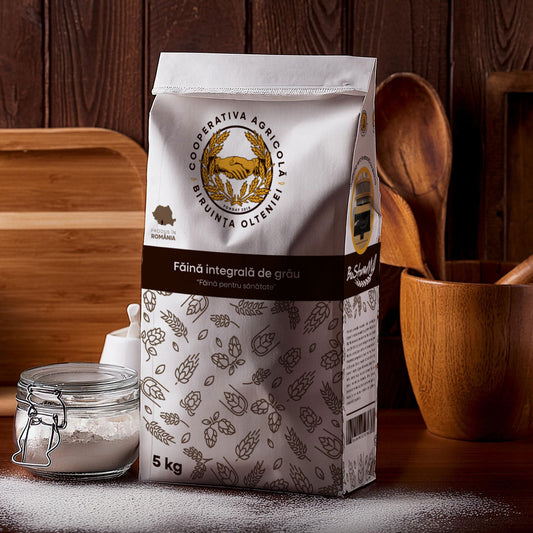
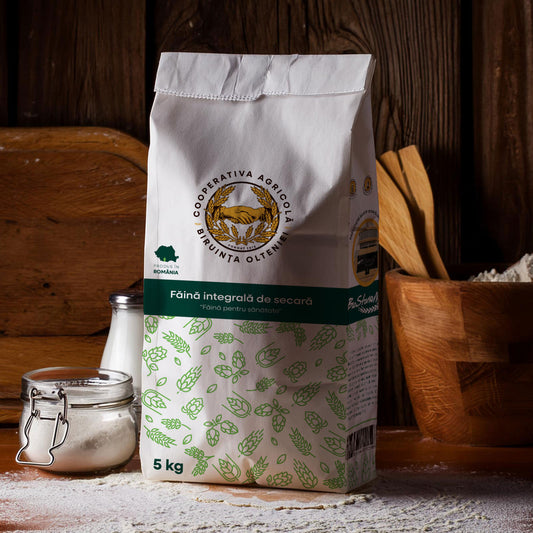
What is Whole Wheat Flour? How to Use It in the Kitchen
People are increasingly interested in eating healthy. They look for clean, locally produced, and fresh ingredients. If you want to eat store-bought bread, the alternatives to a properly made bread using healthy flour are very few. That is exactly why a large part of those who order flour from us are home consumers: women who prefer to knead bread at home and enjoy the taste of real bread, just as we used to some time ago.
Many of those over 30 grew up in the countryside and know this taste, look for it, and appreciate it.
When we refer to clean flour, we have in mind not only the grains (the varieties used) but also the way they are milled. A clean flour, which resembles what many of us know from our mothers and grandmothers, is whole grain flour. But what does it mean for a flour to be whole grain?
When we talk about health and simple ingredients, we inevitably reach an old truth: quality starts with the raw material and how you process it. Whole wheat flour – also known as wholemeal flour – is one of the clearest expressions of this principle.
What does whole wheat flour mean?
The word integral (whole) comes from întreg (whole, complete). Whole wheat flour is obtained by milling the entire wheat (or rye) grain, without separation and without removing its natural components.

What are these components? The wheat grain has three essential parts:
- the bran – the outer layer, rich in fiber;
- the germ – the living part of the grain, containing natural fats, vitamins, and minerals;
- the endosperm – the part rich in starch and protein (gluten).
A whole wheat flour with that good taste from our childhood contains all these elements in exactly their natural proportions. In refined flour, large industrial processors almost exclusively use the endosperm, but whole wheat flour retains the full nutritional potential of the wheat.
This is why, visually, whole wheat flour is not necessarily attractive to some, as its color is darker. Whole wheat flour and whole rye flour have a denser texture, and the taste is clear: of real grain, slightly sweet, with nutty and earthy notes. It is a flour you can feel, not one that disappears into the dough.
How do we use whole wheat flour in the kitchen?
In what types of dough can we use whole wheat flour? In what types of dough can we use whole rye flour?

Whole wheat flour is suitable for baked goods where structure, taste, and consistency matter.
Bread and leavened products
It is ideal for:
- 100% whole wheat bread;
- rustic breads;
- sourdough breads;
- breads with seeds or grains.
We also have customers who prepare homemade whole wheat pasta with eggs and various vegetables, or pizza from wheat and rye flour. In Italy, whole wheat flour already has a tradition, and many use it for pasta, resulting in a product with a more pronounced taste and a heartier texture.
Whole wheat flour is also ideal for all sourdough doughs, especially since it supports fermentation due to its higher content of enzymes and nutrients, giving the breads a complex and stable taste.
Some of Biruința Olteniei's customers have told us they successfully used it when preparing flatbreads, unleavened bread, and homemade pie or shawarma wraps.
It works very well in crackers and savory biscuits, including cheese straws, salées, and savory tarts.
You can also use whole wheat flour in making pancakes, muffins, etc. If we do an exercise and go back in time a bit, especially if you are one of those people who knows the taste of real bread, a series of doughs that our mothers, grandmothers, and relatives made in the countryside come to mind.

Back then, people milled wheat almost like we do, without separating the bran from the rest of the grain's elements. Therefore, following our logic and appealing to memory, we can identify exactly what types of doughs it is suitable for, to achieve that taste of yesteryear that many talk about and even more are looking for.
For delicate cakes or highly aerated doughs, we recommend combining it with white flour for balance. Generally, we recommend premium white flour for sweet breads (cozonaci) and cakes.
How do we work with whole wheat flour? How do we bake the doughs and what must we consider?
Whole wheat flour behaves differently than white flour. Many of our customers come and tell us they don't know how to work with the whole wheat flour we produce, because they are using this type of flour for the first time. Many blame the flour for their failure, but the truth is that there are no aspects regarding the flour that need correcting; rather, we need to know what to do to work correctly with it.
Why does whole wheat flour need higher hydration?
Bran absorbs a lot of liquid. Whole wheat doughs need more water to become elastic and workable. Besides a larger amount of water, we also need a bit more patience. In all good things, time and patience are key aspects.
A whole wheat flour needs a hydration rest (you will also find the term "autolyse" for this process). To correctly hydrate whole wheat flour, we must let it rest for at least 20–30 minutes. This rest helps the bran soften and improves the final texture.
Careful kneading
We need to knead the dough carefully. Why? Because bran particles can affect the development of the gluten network. Gentle methods, like successive stretch and folds, are more effective than aggressive kneading.
We will notice that products made from whole wheat flour are naturally denser and more filling. This is not a defect, but a characteristic of whole grains.
How do we store whole wheat flour?
What should we be very careful about? How do we enjoy the quality of whole wheat flour for a longer time? In other words, what are the storage conditions to avoid altering its properties?
Due to the natural fats in the germ, whole wheat flour oxidizes faster. We recommend storing it in airtight containers, in a cool place.
What are the general nutritional values of whole wheat flour?
For 100 g of whole wheat flour:
- 330–350 kcal
- 12–15 g protein
- 60–75 g complex carbohydrates
- 10–14 g fiber
- 2–3 g natural fats
It is rich in:
- B-complex vitamins (B1, B3, B6, folate);
- vitamin E;
- minerals: magnesium, iron, zinc, manganese, selenium, phosphorus.
How do all these nutritional values help us? Fibers support digestion, satiety, and glycemic balance. Minerals and bioactive compounds contribute to metabolic and cardiovascular health.
Why should we opt more for whole wheat flour?
Refined white flour is stable and predictable, but it does not excel in nutritional content. Whole wheat flour is more demanding in terms of handling and storage, but it delivers on taste and consistency.
A bit of historical context
The history of whole wheat flour is long, spanning thousands of years. In the beginning, milling wheat was simple: wheat was crushed with stones. The whole grain was crushed, without separating the elements from the wheat. The bread of ancient Egypt, Rome, and medieval Europe was made from such flours: nutritious, dense, and filling.
In the 19th century, things changed majorly. Industrial mills appeared, allowing the separation of bran and germ. People could enjoy a white flour that was more pleasing to the eye, finer in texture, with a longer shelf life, but all these benefits came at the expense of nutrients, at the expense of taste, and at the expense of a better ingredient for our health. People could no longer enjoy a whole wheat flour rich in fiber and micronutrients.
Recently, however, people have become more informed and, out of the desire to eat healthy, have started buying and consuming whole wheat flour again. Many countries, much more advanced than us, which lost the taste of real bread before we did, realized all these disadvantages of ultra-processed white flour and developed a true culture around whole wheat and whole rye bread.
A customer told us that in 2013, during an Erasmus program, she had the opportunity to taste no fewer than 32 types of whole wheat and rye bread in a student dorm in Germany.
So, if you are still hesitating between appearance and taste, you have every reason to choose whole wheat flour for bread and other baked goods. This way, you will enjoy a complete food, with an uninterrupted history of thousands of years. Whole wheat flour fed civilizations, supported communities, and remains a solid foundation for a balanced diet. Whole wheat flour is the truest expression of the wheat grain, in its natural and whole form.