Top common mistakes when baking sourdough bread
Tell the truth, how long did it take you to gather the courage to make sourdough bread at home? The idea of difficulty remained stuck in my mind when I read the newsletter of a mother who moved to the countryside, who mentioned that she practices her patience by making sourdough bread. :) If it took me years for sweet bread (cozonac), for sourdough bread I think I would have needed decades to muster up the courage, but luckily for all the online sourdough bread communities. :)
Sourdough bread has something almost magical for those who want to consume healthy bread, prepared at home. It contains water, flour, salt, and requires patience. That's it. And yet, of all types of bread, it is one of the hardest to make, which is precisely why there are many courses on the market to clarify things for you. Sometimes it doesn't rise enough, other times it turns out too dense, too sour, too wet, or it spreads flat instead of developing beautifully in the oven.

Photo credit: Diana Conea (@Iubesc.Natural).
From the specialized articles consulted, I found out that the problem does not necessarily stem from a baker following a wrong recipe, but from omitting certain seemingly trivial aspects that contribute to the final result. If you understand what happens in the dough, the results become much better and more consistent, and because a large portion of our buyers prepare sourdough bread at home, we wanted to support them with this small guide, which includes the most common mistakes people make when preparing sourdough bread — and how you can avoid them.
1. Using a starter that is not active enough
One of the biggest mistakes is starting the dough with a tired, poorly fed starter, or using it too early. Many see a few bubbles and think it is ready. In reality, a good starter must be visibly active, aerated, double or even triple its volume, and have a pleasant, slightly sour smell, but not pungent.
If the starter lacks strength, the bread will rise poorly, the crumb will be dense, and fermentation will be unpredictable.
What to do: feed your starter regularly and use it at its peak, when it is full of life. A good, fresh flour can help enormously in developing a vigorous starter. To see what a properly fed starter should look like, watch the reels created by our collaborator, Diana Conea (@iubesc.natural).
2. Not understanding how important temperature is
With sourdough bread, temperature changes everything. Fermentation goes faster in a warm kitchen and slower in a cold one. Many blindly follow the time in the recipe without taking into account that those 4 hours of fermentation can be too much in the summer and too little in the winter.
The result? Under-fermented dough or, on the contrary, over-proofed dough.
What should you do here? Follow the signs of the dough above all, not just the clock. A well-fermented dough becomes more elastic, more aerated, and visibly increases in volume. Time is only a guideline.
3. Adding too much flour because the dough seems sticky
I think this is one of the most common mistakes our customers make. Sourdough bread dough is often softer and stickier than yeast bread dough. Beginners panic and keep adding flour until the dough becomes easy to handle. Except, in doing so, they end up with a heavy, dry, and compact bread.
What should you do? Resist the temptation to correct everything with flour. Work with slightly damp hands, perform stretch and folds, and give it time. As the gluten develops, the dough becomes more stable.
4. Not adapting hydration to the type of flour
Not all flours absorb water the same way. Here a very common mistake occurs: people use the same amount of water, regardless of the type of flour. An additive-loaded white flour and a whole flour behave completely differently. And a stone-milled flour has its own personality: it absorbs water differently, can ferment differently, and demands more attention to the consistency of the dough.
Our recommendation is not to treat the recipe as a rigid formula. Learn to read the dough. Personally, I watched Diana Conea's clips and pictures a lot to see what the dough looks like, as well as what the starter looks like. If you use quality whole flour, especially stone-milled flour, start with a balanced hydration and adjust gradually.
5. Not allowing enough time for autolyse
Autolyse is that simple step where flour and water are left to rest before complete kneading. Many skip it out of haste, but experienced bakers and homemakers who know the logic behind it respect this time because they know it is a step that can make a real difference: the dough becomes more supple, gluten begins to form naturally, and the bread stands a better chance of turning out well.
How long should you leave the flour to rest? Let the flour and water stand for 20–60 minutes before adding the salt and starter, if the recipe allows. Also follow the indications of each individual recipe, respecting the recommended waiting time.
6. Kneading too much or too little
With sourdough bread, it is not necessarily about intensive kneading, but about the gradual development of structure. Some barely touch the dough and wonder why it lacks strength. Others work it too aggressively and end up tearing it, heating it up too much, and ruining its texture.
How should you proceed? Use a combination of initial mixing, resting, and performing folds during fermentation. The dough must gain tension and elasticity, not be beaten to exhaustion.
F
Photo credit: Diana Conea (@Iubesc.Natural).
7. Not respecting bulk fermentation
Bulk fermentation is one of the most important stages and, at the same time, one of the most misunderstood. If you stop the process too early, the bread will turn out compact and without volume. If you prolong it too much, the dough loses its structure, becomes too soft, and spreads flat.
What are the signs that the dough is almost ready? It has visibly grown, has bubbles, feels more alive to the touch, and holds its shape better after folds.
Pay attention and observe the dough. It's not for nothing that many say the trade is stolen by watching. Observe others, but also observe what you do.
8. Shaping the bread without creating tension
The final shape matters more than many think. A carelessly shaped dough will not have enough surface tension and will spread out instead of rising beautifully upwards.
During preshaping and final shaping, work gently but firmly. The goal is to create a well-stretched "skin" on the surface, without completely knocking out the accumulated air.
9. Over-proofing the bread before baking
Over-proofing is one of the most frustrating mistakes because the dough can look promising, but it no longer has strength in the oven. It collapses, opens uncontrollably, or remains flat.
Many confuse a very soft and puffy dough with a perfectly proofed one. But in fact, sometimes it is already past its optimal point.
Test the dough carefully and monitor its elasticity. If the finger indentation remains deep and the dough does not spring back at all, it might have stood for too long.
10. Baking the bread in an insufficiently heated oven
Sourdough bread needs a thermal shock at the beginning of baking. If you put the dough into an oven that is only quite warm, you won't get that spectacular initial oven spring, and the crust and structure will suffer.
We recommend preheating the oven very well, and if you use a Dutch oven with a lid, a heavy tray, or a baking stone, preheat them sufficiently beforehand as well.
11. Failing to provide steam at the beginning of baking
Steam helps the crust remain elastic during the first few minutes, allowing the bread to expand. Without it, the crust sets too quickly, and the bread no longer has room to develop.
What you need to do: bake in a covered vessel or create moisture during the first few minutes, according to the method that works best for your oven.
12. Cutting the bread immediately after taking it out of the oven
Yes, it smells incredible. And yet, one of the most common mistakes is cutting the bread too quickly. The crumb continues to stabilize even after baking. If you cut it hot, you might get the impression that it is gummy or underbaked, though it just hasn't settled yet.
After taking the bread out of the oven, let it cool down thoroughly before slicing it. Patience is part of the recipe.
13. Expecting perfect results from the very first attempts
Sourdough bread is not just a recipe, but a relationship with the ingredients, temperature, time, and your own working pace. Many give up after one or two failed loaves of bread, even though those exact attempts teach them the most.
What helped me? I wrote down each time what flour I used, how active the starter was, what temperature I had in the house, how long fermentation lasted, and how the bread turned out. That's how I truly understood the process.
Tip: flour matters a lot

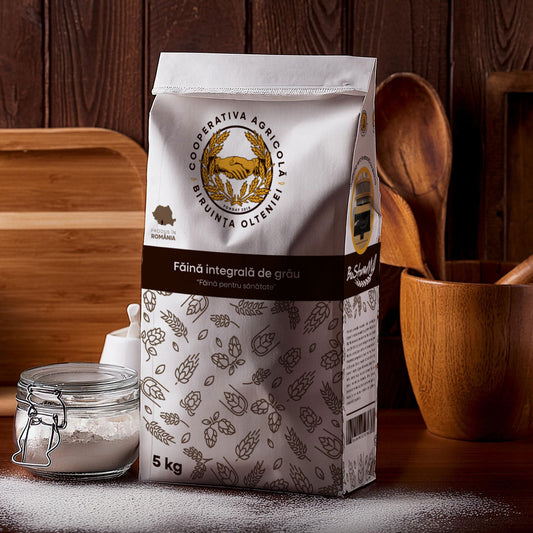
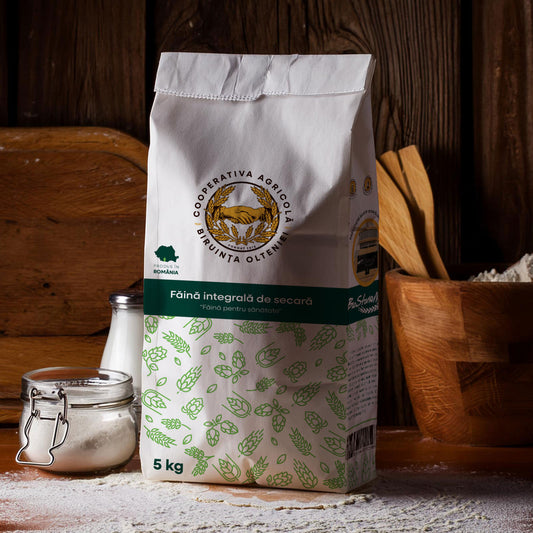
When making sourdough bread, every detail matters, and flour is the foundation of the entire process. A quality flour offers not just taste, but also predictability, structure, and balance. Especially when choosing stone-milled flour, you must work carefully, because you are dealing with a live, tasty ingredient with a natural behavior, not a standardized product without personality.
Keep these tips in mind, respect them, and tell us in the comments what other mistakes you have made and how you corrected them.